


In the last week of April the sea along the French Riviera sits at around 15°C. The sea off Sagres, on the south-western corner of Portugal, sits at around 16. For anyone planning to get into it, the difference is nothing: both are cold, both demand either a short and deliberate immersion or a wetsuit. That single comparison takes apart the usual reason for booking the Mediterranean in spring, because the Mediterranean’s real advantage is not that it is warm in April. It is that it turns warm in June and holds the warmth into October, which most of Europe’s Atlantic coast never manages at all.
The shoulder season — roughly April to early June, then September and October — is therefore the only window in which the two coasts can be compared honestly. It is also the window in which the Atlantic side is at its strongest. Not warmer: emptier, greener, better lit, and attached to towns that are busy doing something other than serving visitors. The trade is genuine and it runs both ways, and it is worth setting out plainly before anyone flies to Faro or Biarritz in May expecting Mediterranean conditions.
The Arithmetic of Water Temperature
Approximate monthly averages for open coastal water, rounded to the nearest degree, show both the problem and the opportunity.
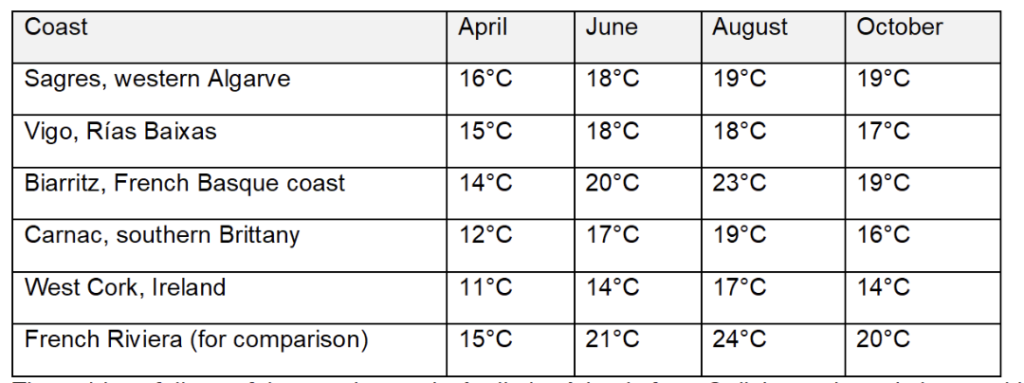
Three things fall out of those columns. In April, the Atlantic from Galicia southwards is no colder than the Mediterranean, and southwest Portugal is marginally warmer. From June onwards the Mediterranean pulls decisively ahead and never gives the lead back. And there is an oddity in the Sagres row: the water barely moves between April and October, shifting about three degrees across the whole season while the Riviera swings nine.
That flatness is upwelling. Northerly winds running down the north–south Portuguese coast push surface water offshore and draw colder water up from beneath, and the effect is strongest in precisely the months when the air is hottest. A comparative study of upwelling on the western and northern Iberian coasts, published in Continental Shelf Research, identified upwelling-favourable northerlies from April to September, with the coldest coastal anomaly in August and September. The practical consequence is counter-intuitive: a west-facing Portuguese beach in August can be colder than the same beach in October. The Portuguese Institute for Sea and Atmosphere publishes sea surface temperature maps and forecasts for the whole Iberian margin, and the cold band hugging the coast through midsummer is usually plain on them.
What the Cold Water Buys
The compensations are specific rather than vague. The first is space. Mediterranean resort coasts are built for July and August and are measured by how many people they can hold; Atlantic coasts, on the whole, are not, and in May a long beach in the Alentejo or the Landes can hold a dozen people on a weekday rather than a few thousand.
The second is the state of the land. The Mediterranean’s own shoulder-season argument is usually made about temperature, but the landscape keeps its own calendar. Southern Spain, Provence and the Italian coast are green in April and burnt brown by late June. The Atlantic margin stays green far longer, and in Galicia, Brittany and the Irish southwest it stays green all summer, because the rain that makes the weather unreliable is the same rain that keeps the hills from drying out.
The third is the character of the towns, and this is the difference that shows up most strongly out of season. A great deal of the Atlantic coast is still run by fishing, shellfish farming and agriculture rather than by visitors, which changes what is open in May and why. Mussel rafts work the Galician rías all year. Boats land at Capbreton, at Baltimore, at Sines and at Audierne in April as readily as in August. The consequence is that the bakery, the chandlery, the fish market and two or three of the restaurants are open in the shoulder months because the town needs them, not because the season has started — whereas a purpose-built Mediterranean resort in April can be a line of shuttered frontages with one café serving the staff. The reverse also holds: an Atlantic fishing town at its own convenience is not trying to charm anyone, and the shoulder-season traveller who wants to be looked after will find the Mediterranean better at it.
The fourth is light, though this needs care, because latitude does not work the way it is often claimed. Sagres sits further south than Nice and has shorter days than Nice in June. The advantage lies elsewhere. Almost all of this coast faces west, so the sun sets over open water rather than behind a headland, and the long low light of a May evening lands on the sea instead of leaving it. Clocks help too: Galicia keeps central European time at the extreme western edge of the continent, which pushes the Vigo sunset to about 22:15 around the solstice. Further north, real day length does take over — the longest day in west Cork runs roughly an hour and a quarter longer than on the Côte d’Azur.
Portugal’s Southwest, from the Alentejo to Sagres
The stretch between Sines and Cape St Vincent is the clearest case on the whole Atlantic seaboard. It is protected as the Parque Natural do Sudoeste Alentejano e Costa Vicentina, which has kept development low and the cliff tops largely unbuilt, and the beaches sit at the bottom of ravines rather than at the end of promenades. Milfontes, Almograve and Zambujeira do Mar are small towns with fishing harbours and a handful of restaurants. At Cabo Sardão the cliffs run 40 to 50 metres above the water with rock columns standing offshore, and white storks nest on them through late winter and spring, which is unusual enough that birdwatchers plan trips around it.
Season matters enormously here, and not only for comfort. Water temperature is the honest dividing line, and in April neither coast is warm. But the Atlantic side of Portugal is at its best precisely then: the Alentejo cliffs are still green, the western Algarve beaches are empty on a weekday, and the summer northerly has not yet settled in to blow sand along them every afternoon.
That wind has a name, the nortada, and it is the most underrated variable on this coast. It blows mainly from June to September, mostly from the north-northwest, and builds through the afternoon. On the exposed beaches around Carrapateira — Amado, Bordeira, Castelejo — a calm, hot morning can turn sandblasted by two o’clock in July, which is why surf schools and walkers both start early. Around the corner at Sagres, and eastwards towards Lagos, the coast turns to face south and the same wind becomes an offshore breeze, which is why that small headland holds so much of the region’s activity.
Galicia, Asturias and the Cantabrian Shore
North of the Portuguese border the coastline breaks into the Rías Baixas, drowned river valleys that behave more like sea lochs than bays. The water inside them is calmer and slightly warmer than the open coast, mussel rafts cover whole inlets, and the wine on every list is Albariño from vineyards a few kilometres inland.
The Cíes Islands, at the mouth of the Vigo ría, show how carefully the shoulder season has to be planned here. They form part of a national park with a hard visitor cap, and permission from the Xunta de Galicia must be obtained before a ferry ticket can even be bought. In the main season — Easter, then 15 May to 15 September — roughly 1,600 to 1,800 people are admitted daily. Outside it the public ferries stop and access narrows to organised groups with an accredited guide, 250 to 450 a day. An April itinerary that assumes the Cíes are simply there to be visited will not work.
Further east, the Costa da Morte and then Asturias and Cantabria give up the rías for something harder: short cliff-backed beaches, tidal coves that vanish twice a day, and the Picos de Europa close enough behind the shore to be seen from it. Cudillero, Llanes, Comillas and San Vicente
de la Barquera are the natural bases. The local case for May and September is largely about rain: these are among the wettest coasts in Europe, and the shoulder months are not the dry ones, merely the ones with fewer people sheltering from the same shower.
From the Basque Coast to the Pink Granite
The French Basque country is where the Atlantic briefly stops being a compromise. Biarritz water reaches about 20°C in June and 23°C in August, close to Mediterranean figures, and the run of San Sebastián, Hondarribia and Biarritz offers urban coastal life the Mediterranean would recognise. The argument for the shoulder months here is not about temperature at all but about crowding and cost, both severe in August.
North of Biarritz the Landes begins and the coast becomes a single straight line of sand and pine for well over a hundred kilometres. Its one interruption is the Gouf de Capbreton, a submarine canyon starting a few hundred metres offshore between the Capbreton pier and the Hossegor beaches and falling away to around 4,000 metres. It focuses swell into La Nord, the best-known wave on the French coast. The Landes in late May is a different place from the Landes in August, when the campsites fill and the access roads queue.
Southern Brittany, around the Golfe du Morbihan, Quiberon and Belle-Île, means cooler water and messier weather, offset by granite islands, Neolithic alignments and a coastline so indented that walking becomes the point. The coast path, the GR34 or sentier des douaniers, runs more than 2,000 kilometres from Mont-Saint-Michel to the Saint-Nazaire bridge, and the Brittany tourist board recommends mid-April to late June for walking it, with September as the alternative. The same path carries on north to the Côte de Granit Rose around Perros-Guirec and Ploumanac’h, where the rock really is pink and low spring sun makes the most of it.
West Cork, Kerry and the Cost of Arriving Early
Ireland is where the trade is hardest to defend on paper and easiest to defend in person. West Cork water averages about 11°C in April and does not reach 17 until August, and the weather is unreliable in a way no planning can soften. What the southwest offers instead is the Beara, Sheep’s Head and Mizen peninsulas, Baltimore and the islands off it, the Dingle peninsula and the long strands of Kerry, and small harbours that stay functional out of season because the local population uses them.
Arriving early carries a cost, much the same across the Atlantic arc. Lifeguard cover on the West Cork beaches runs weekends only through June, goes daily for July and August, and finishes in the first days of September. Portugal designates several hundred official bathing waters each year, but they do not all open at once: a handful of municipalities begin in early May and most of the coast follows only in June. The honest shoulder-season checklist is short.
- A 3/2 mm wetsuit covers 15 to 17°C water; a 4/3 is the sensible choice at 14°C and below.
- Lifeguards, beach cafés, island ferries and seasonal hotels often do not start until June, and many close again in mid-September.
- Rain is a planning assumption rather than a risk from Brittany northwards, and in Galicia and Asturias in any month.
- On the Portuguese west coast, mornings are calm and afternoons windy from June onwards; itineraries should be built around that, not against it.
- Tides matter on the Atlantic in a way they do not in the Mediterranean, and some coves and causeways exist only at low water.
Where the Mediterranean still wins deserves saying without hedging. From June to September it delivers reliable sunshine and water warm enough to swim in without thinking about it, weeks at a stretch, and no part of the Atlantic coast except perhaps the Basque corner comes close. A holiday built around swimming, in July, belongs on the Mediterranean.
Where the Season Actually Starts
The dates that matter are not the ones in the brochures. On the Atlantic the season starts when the landscape is at its best and ends when the infrastructure shuts, and the two are badly out of step. Southwest Portugal peaks in April and May, while the cliff tops are still green and before the nortada sets in — a month or two ahead of most of its beach services. Galicia and the Cantabrian coast work from May, the island ferries coming online around mid-month. Brittany’s tourist board points at mid-April to late June. Ireland’s southwest is best in late May and early June for light, and in September for water, and its lifeguards cover neither properly.
What follows is simple enough. The Atlantic shoulder season rewards self-sufficiency — carrying a wetsuit, booking accommodation that opens early, keeping plans loose enough to move around weather, and treating an empty beach in a cold wind as the point rather than the problem. For a traveller who wants the sea warm and the kiosk open, the Mediterranean in June remains the better answer, and there is no shame in saying so.