


Ten minutes west of Kranjska Gora the country ends. The road passes through Rateče, slips across the Italian border, and the signage changes language without ceremony. Turn north instead and Austria lies over the Korensko sedlo crossing or through the Karavanke tunnel. Kranjska Gora occupies the last broad stretch of the Sava Dolinka valley, the Julian Alps to the south and the Karawanks to the north, with a World Cup slalom hill at the edge of the village.
A Small Ski Area, Honestly Measured
The numbers shape everything else. The lifts work a band of mountain between roughly 807 and 1,282 metres, a vertical of under 500 metres. There are around 20 kilometres of marked piste served by about 15 lifts, graded at roughly ten kilometres of easy terrain, eight of intermediate and two of difficult.
A strong skier will have seen all of it by lunchtime on the second day. That is less a criticism than a specification. What Kranjska Gora offers instead is a nursery area at the bottom of the village and gentle blue runs wide enough for a family to spread across. The exception is Podkoren 3, the competition slope that has hosted men’s World Cup racing since 1983; it reaches a maximum gradient of about 30.5 degrees and is reckoned the steepest groomed run in Slovenia.
Altitude is the real constraint. A base below 900 metres is low by Alpine standards, and in a warm winter the resort leans heavily on snowmaking, which covers a large share of the pistes. The season generally runs from early December to early April, and both ends are weather-dependent in a way that higher resorts are not.
The Valley Next Door
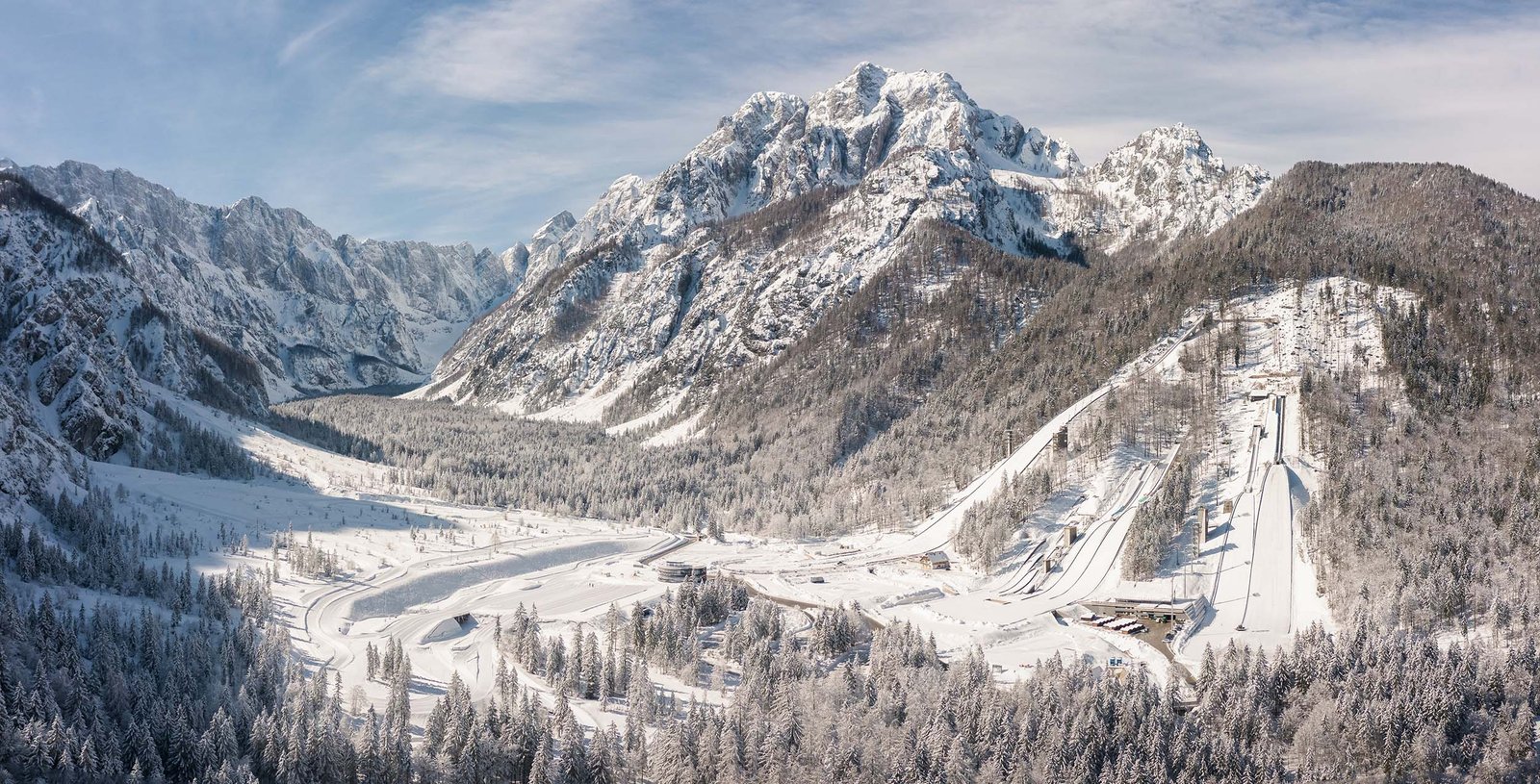
Planica sits a few kilometres west, at the mouth of the Tamar valley, and it is why Kranjska Gora appears on sports calendars far more often than its piste map would justify. The first ski jump past 100 metres was recorded there in 1936. The flying hill that followed, Letalnica bratov Gorišek, was built in 1969 and now has a hill size of 240 metres with its K-point at 200; the men’s world record set on it in March 2025 stands at 254.5 metres.
Since 2015 the site has been the Planica Nordic Centre, a roughly 40 million euro complex holding eight jumping hills in all — the flying hill, a large hill, a normal hill and five smaller ones for juniors — plus a wind tunnel, a museum and a restaurant in the central building. Out of season, with the inrun empty, the hill conveys its scale better than any camera angle.
Snow Without Lifts
Several of the better things to do in this corner need no lift pass at all.
- Cross-country trails are groomed daily at the Rateče centre and continue from Planica up the Tamar valley to the hut at its head. A long valley route links Zgornja Radovna, Mojstrana, Gozd Martuljek, Kranjska Gora, Rateče and Planica over some 40 kilometres when snow allows.
- Lake Jasna, two small man-made lakes about twenty minutes’ walk from the centre, with a bronze Zlatorog — the horned ibex of local legend — beside the water.
- Zelenci, a reserve near Rateče where a spring pool regarded as a source of the Sava Dolinka stays an improbable turquoise through winter.
- A floodlit night loop in the village, free like most of the tracks; Rateče charges a small fee, around six euros in recent seasons.
One road is simply unavailable. The Vršič pass, at 1,611 metres the highest in Slovenia, climbs out of Kranjska Gora in 24 hairpins and drops into the Trenta valley in 26 more. It was cut by Russian prisoners of war during the First World War, and the wooden Russian Chapel on the climb commemorates those killed by an avalanche. In winter the pass is shut by snow and cars get no further than the hut at Gozd, which turns the Soča valley, twenty-odd kilometres away, into a half-day drive around through Italy.
Arriving
There is no railway station in the village; the nearest line runs down the valley at Jesenice, and buses from Ljubljana connect through it. Most visitors come by road. The run from Ljubljana Airport to Kranjska Gora covers about 66 kilometres and takes roughly three quarters of an hour in clear conditions, longer under fresh snow (Taxi 2 Ski works the route through the season). Klagenfurt is a comparable distance over the Austrian border and Trieste about an hour away, which gives this village three usable airports in three countries.
Practical Notes
Kranjska Gora rewards the groups it suits. Families with small children, nervous beginners and competent intermediates get good value. Skiers chasing vertical will exhaust the terrain quickly and should treat the village as a base for day trips instead, since the Italian areas around Tarvisio and the Austrian ones beyond Villach are within reach, with motorway on both sides roughly half an hour away.
Border hops need identification even without routine checks, and Slovenian and Austrian motorway tolls are separate systems. Beds in Podkoren and Rateče tend to cost less than in Kranjska Gora itself, at the price of relying on the local bus. The Vršič closure is worth planning around: anyone hoping to combine this valley with Bovec or the upper Soča in one winter week should study the map before booking.