


Few independent watchmakers have influenced modern horology as strongly as Maximilian Büsser (below), the founder of MB&F. His career began at Jaeger‑LeCoultre in 1991, where he learned the fundamentals of Swiss watchmaking under figures such as Günther Blümlein and Henry‑John Belmont.
After leading Harry Winston Rare Timepieces and launching the Opus collaborations, Büsser decided to pursue a more personal vision. In 2005, he founded MB&F, short for Maximilian Büsser & Friends. The name reflected the idea behind the company: a place where watchmaking could be rebuilt through collaboration and imagination rather than convention.
The early years were challenging. Funding was limited, suppliers were cautious, and Büsser’s vision of three‑dimensional mechanical sculptures was far from mainstream. The brand’s first creation, Horological Machine No.1, nearly stalled. Its unconventional architecture required solutions that traditional movement makers couldn’t provide. Independent watchmaker Stephen McDonnell stepped in allowing HM1 to become a reality. That partnership helped establish the collaborative spirit that still defines MB&F.
Over the following years, MB&F built a catalogue that stood apart from anything else in contemporary horology. The Horological Machines explored themes drawn from science fiction, aviation and architecture, while the Legacy Machines offered a more classical interpretation inspired by nineteenth‑century watchmaking. The brand expanded into co‑creations with L’Epée, Reuge and Caran d’Ache, and later introduced M.A.D.Editions as a more accessible entry point. Awards followed, including the Aiguille d’Or at the Grand Prix d’Horlogerie de Genève.
Now, as MB&F enters its third decade, the company has unveiled one of its most ambitious creations to date: HM12 The Guardian, a complete horological concept that pairs a wristwatch with a fully realised robot companion.

Where mechanics meet character
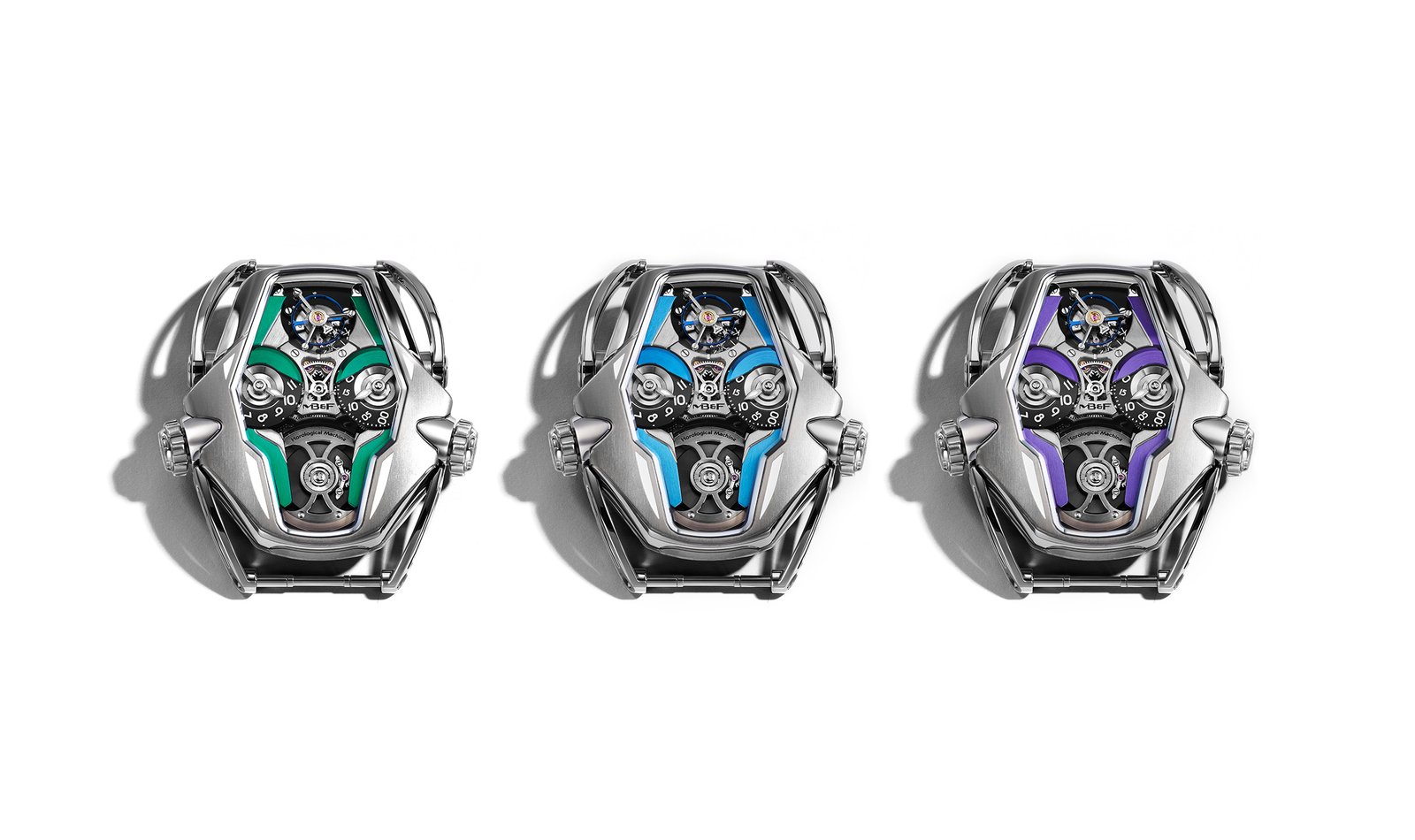
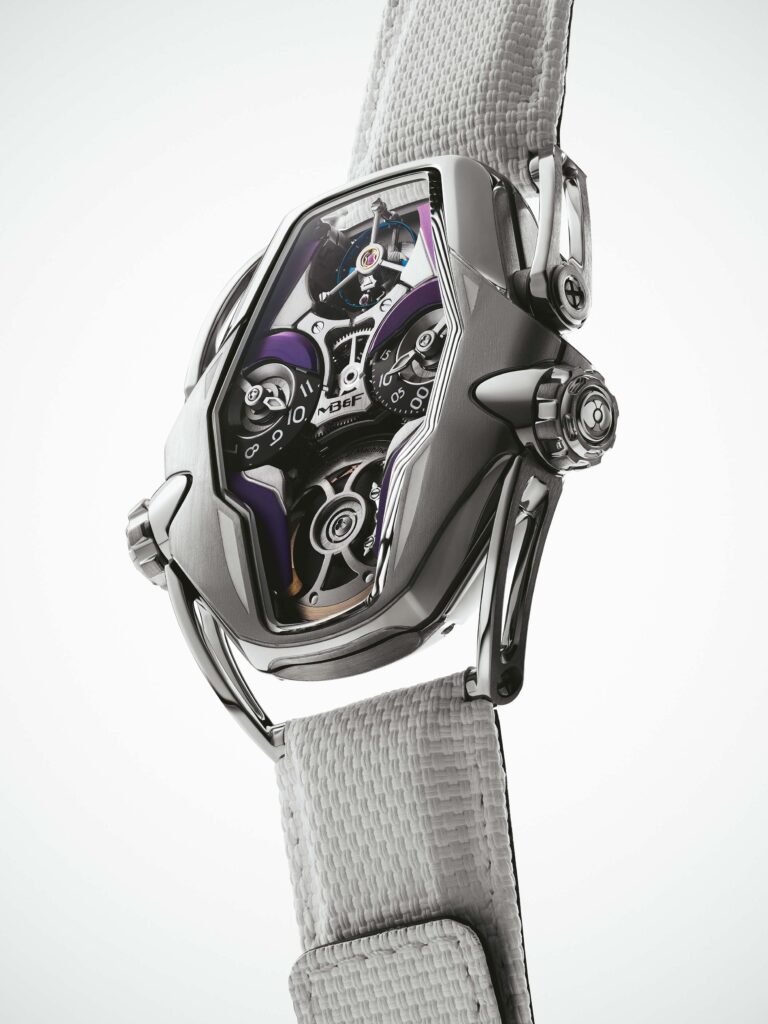
HM12 does not resemble a conventional wristwatch. It presents itself as a robotic face, shaped with clear intent. The jumping hours and trailing minutes form the eyes, displayed on rotating discs that move while the reading point remains fixed. Beneath them sits the micro rotor, sculpted in MB&F’s signature battle‑axe shape, occupying the position of the mouth. Above, the flying tourbillon is exposed under a sapphire structure that acts as the robot’s skull. As MB&F describes it, “the flying tourbillon functions as the brain.”
The design draws from Büsser’s childhood memories of robots and toys, as well as the science fiction imagery of the 1970s and 1980s. Designer Maximilian Maertens, who co‑developed HM12, brings influences from a later generation shaped by Transformers and animated series. HM12 sits at the meeting point of these imaginations, creating a face that feels familiar yet entirely new.
Behind the mask
One of HM12’s most distinctive features is its mechanical face shield, a complication that serves both a functional and narrative purpose. Actuated by the left crown, the shields slide smoothly to reveal or conceal the face. The motion is continuous, and the wearer can stop it at any point. Once the shields reach their limit, the crown disengages to prevent strain.
More than 200 components are dedicated to this system alone. It is fully mechanical and operates independently from the movement. Development required parallel engineering to ensure that the shield mechanism and the timekeeping calibre could coexist without conflict. The finishing of the shield components, including chatons and polished wheels, reflects the level of detail usually reserved for traditional high‑end watchmaking.
The heart of the machine
The HM12 calibre contains 646 components and 86 jewels, with an 84‑hour power reserve. It brings together several of MB&F’s signature mechanical ideas: instantaneous jumping hours, trailing minutes displayed on rotating discs, a flying tourbillon positioned at the top of the head, and a double‑sided micro‑rotor visible from the front. The shield mechanism is entirely independent from the movement, yet engineered to sit within the same compact architecture. From the front, it expresses the bold, futuristic language associated with MB&F’s Horological Machines. From the back, however, it reveals a more classical approach. The bridges are softly curved and hand finished, the mainplate carries a grained texture, and the rotor features a guilloché pattern on a domed face, created with the involvement of Kari Voutilainen’s atelier.
The body of the watch
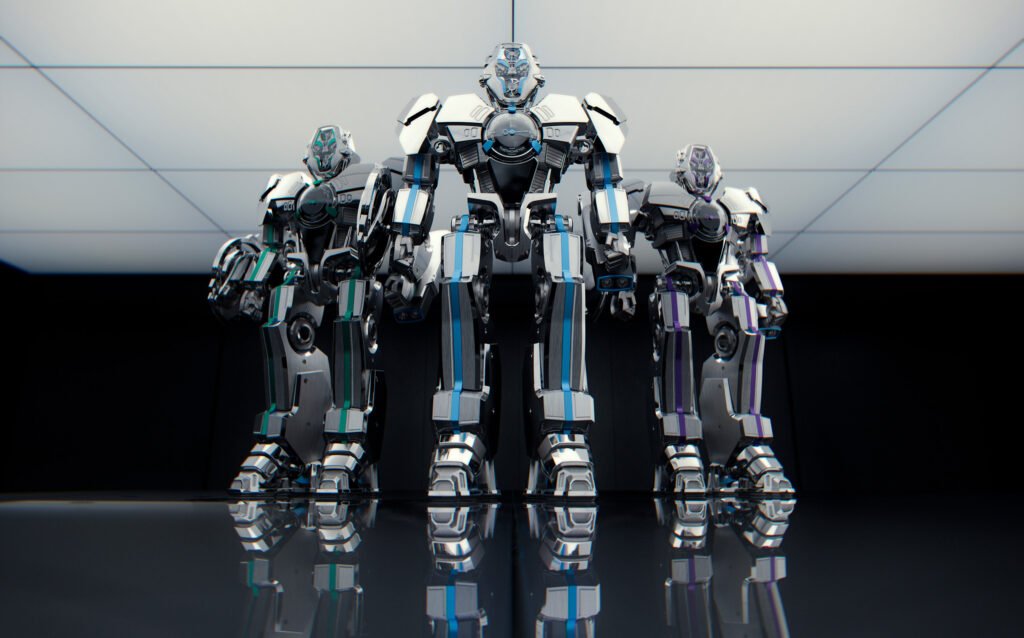
HM12 is designed to detach from its strap and mount onto The Guardian, a 38‑centimetre tall robot developed with L’Epée 1839. This is not a display stand. It is a mechanical body built around the watch. As MB&F notes, “the two are one.”
The Guardian contains 755 components. A mechanical thermometer sits at its chest, acting as the robot’s heart. One arm carries a shield with an integrated loupe for inspecting the movement. The other holds a detachable UV torch that activates the Super‑LumiNova on both the robot and the watch. The strap is stored in a hidden drawer within the base.
Together, the watch and robot comprise nearly 1,500 components, produced in three colour editions. Blue, green and purple, each limited to 12 pieces.
The next evolution
HM12 draws on the ideas that shaped MB&F from the beginning: mechanical storytelling, character‑driven design and a willingness to explore watchmaking from unexpected angles. It also marks a shift within the company. For the first time, a Horological Machine has been conceived and developed by Maximilian Büsser and designer Maximilian Maertens as a dedicated creative pair, giving the project a focused identity within the wider MB&F universe.
As the brand enters its third decade, The Guardian shows how MB&F continues to evolve while staying close to the spirit that defined its earliest creations. It demonstrates that the company’s most engaging work still comes from treating watchmaking as a place for imagination and experimentation.
A rare breed
HM12 The Guardian is produced in three limited editions, blue, purple, and green, with only 12 pieces of each, totalling 36 pieces worldwide. Combining a sci-fi aesthetic with nearly 1,500 components, the piece carries MB&F’s founding ethos into its third decade