


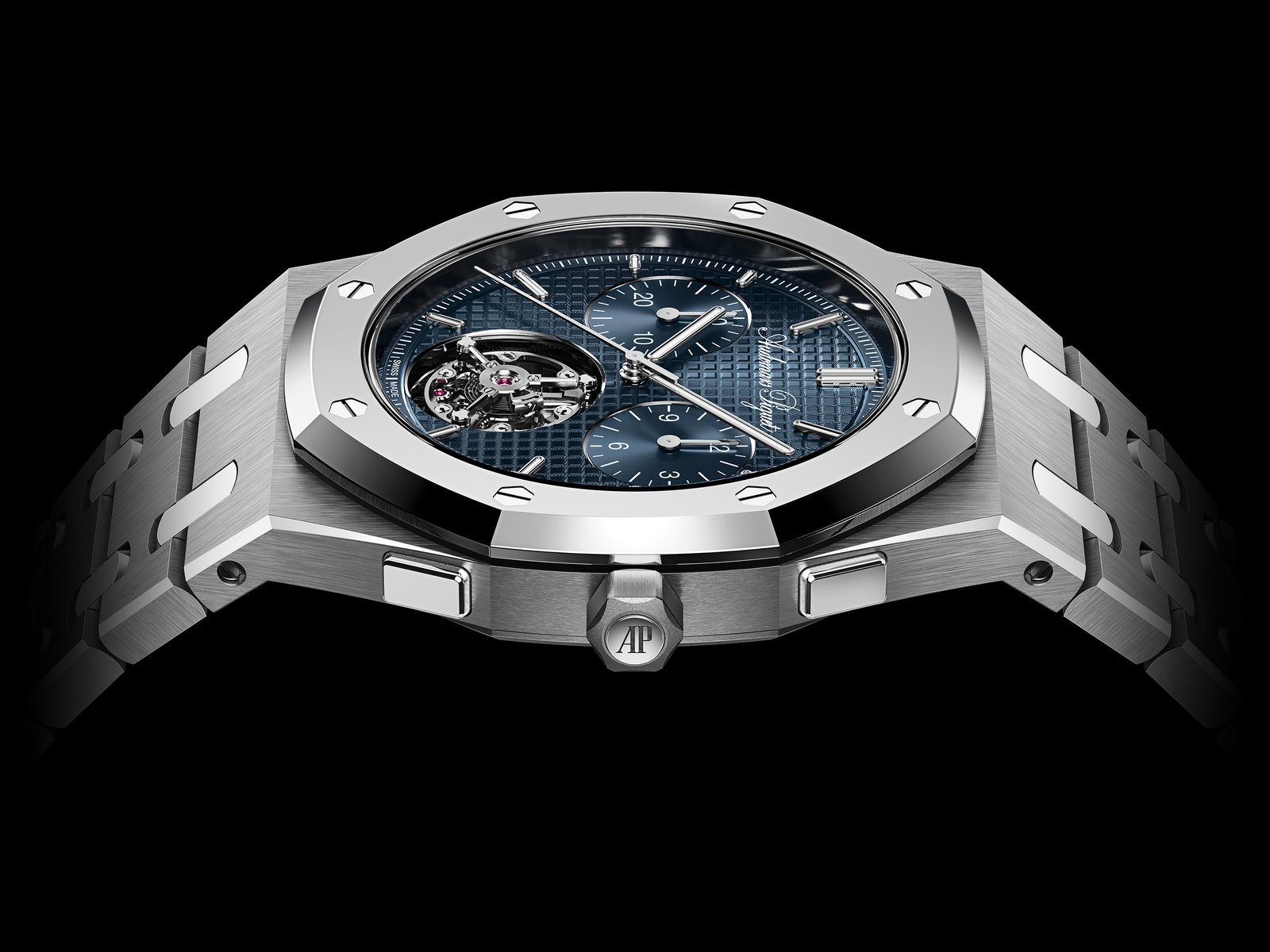
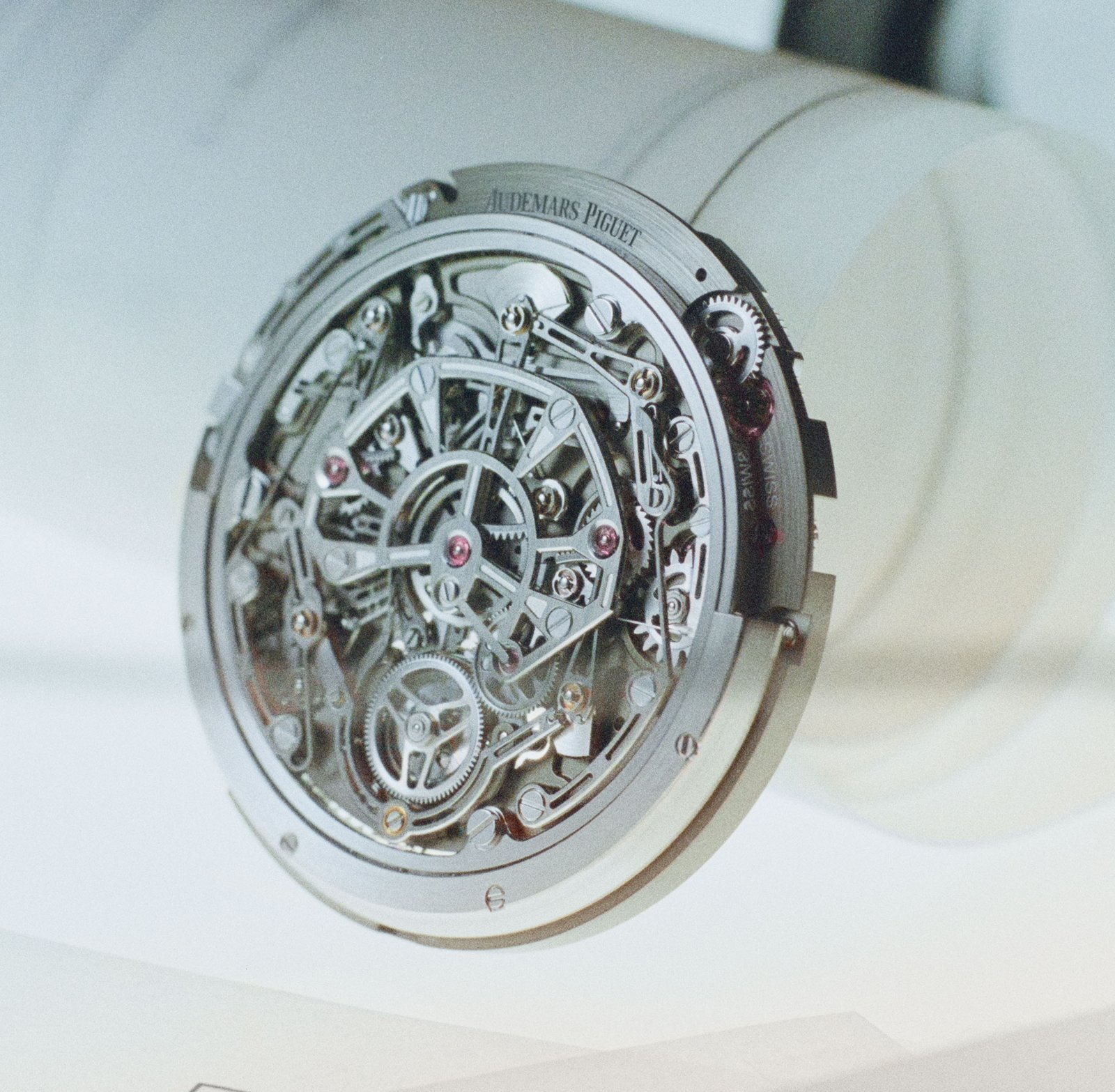
Coinciding with the brand’s 150th anniversary, Audemars Piguet is thrilled to unveil the latest innovation from its R&D department. Combining technical sophistication, performance and iconic design with a new standard of ergonomic refinement, the Royal Oak ‘Jumbo’ Extra-Thin Selfwinding Flying Tourbillon Chronograph RD#5 marks a new era in the history of chronographs and the last iteration of the RD series. Requiring five years of development, this exceptional timepiece houses the all-new Calibre 8100, the inner workings of which have been entirely reimagined and patented to meet the expectations of the most
discerning collectors.
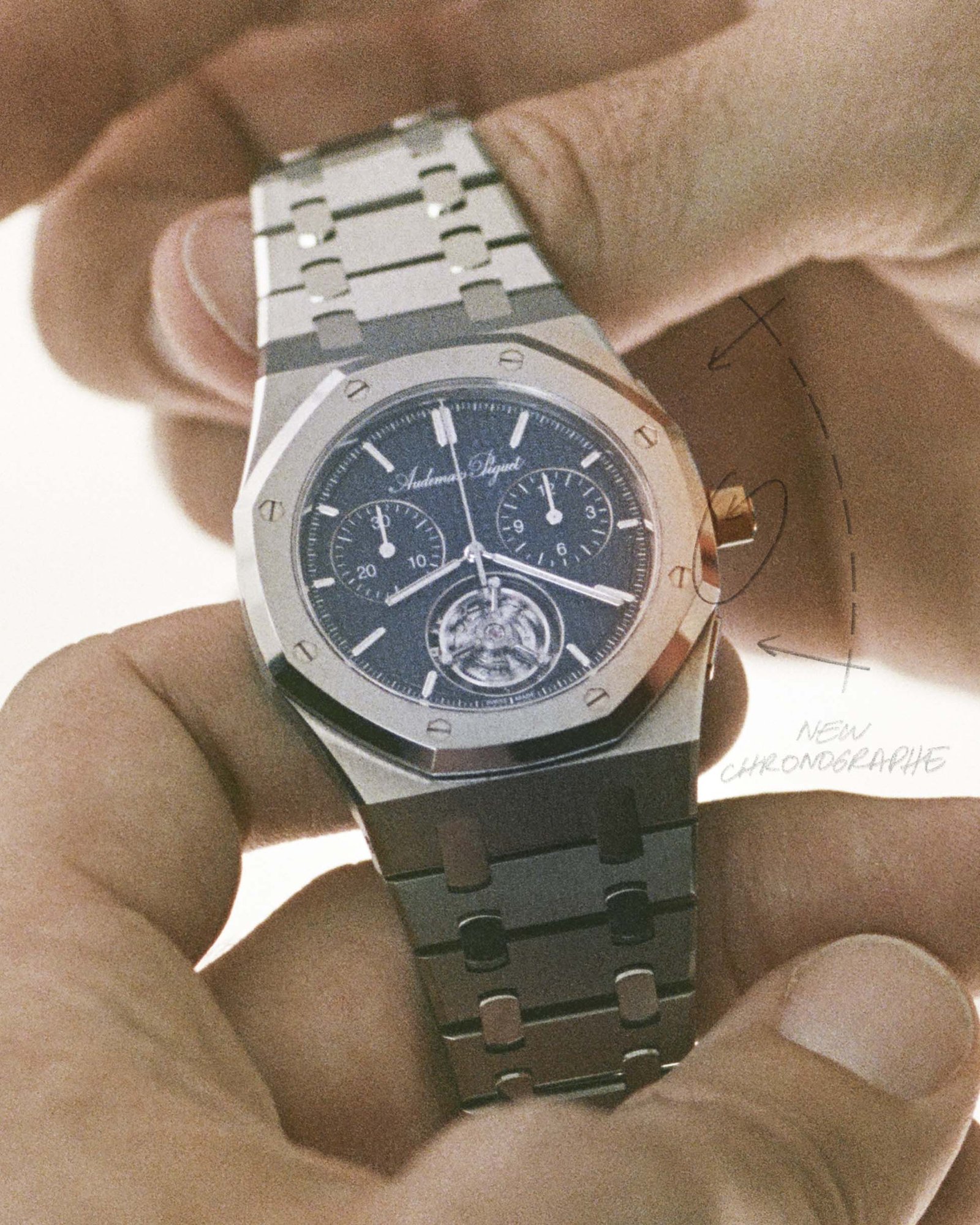
Every detail has been meticulously crafted, pushing the boundaries of ergonomic design to redefine the touch-sensitivity of chronograph push-pieces. Notably, the RD#5 features a rare instant jump minute counter alongside an hour counter and – for the first time in the Royal Oak collection – combines a flyback chronograph with a flying tourbillon. Limited to 150 pieces, this milestone creation is crafted from titanium and precious bulk metallic glass to offer a balance of lightness, durability and brilliance.
Reinvention of an icon
For the first time in its 50-year history, the Royal Oak ‘Jumbo’ is equipped with both a self-winding chronograph and a flying tourbillon – a dual complication that posed significant challenges for the Audemars Piguet teams, given the model’s iconic proportions.
Introduced in 1972 and designed by Gérald Genta, the original Royal Oak earned the nickname Jumbo for its bold proportions, considered oversized for the time. Today, it is highly sought after by collectors and embodies perfect ergonomics with its 39mm diameter and 8.1mm thickness. These features make it the ideal candidate for this new development, where mechanics serve the design.
With user comfort and strict adherence to the line’s aesthetic codes in mind, Audemars Piguet’s R&D experts have completely redesigned the chronograph’s construction to deliver unprecedented tactile finesse while minimising the mechanism’s thickness. The result is a timepiece that unites technical complexity, ease of use and refined visual simplicity.
Ergonomics at your fingertips
From the outset, the #RD5 project was led by a desire to create a chronograph that offers an elevated level of comfort. Its development was guided by a comprehensive ergonomic study – encompassing the movement, case and design – to identify user expectations and create tailored solutions to meet them. In keeping with the brand’s focus on innovation, this approach signals a new way of addressing both the client experience and the conception of complicated timepieces.
The first innovation lies in the push-pieces flanking the crown positioned at 3 o’ clock. In a contemporary chronograph, these typically require significant pressure to engage. “Their travel – that is the distance they must be pressed – is often 1mm or more and requires a force of around 1.5kg,” explains Giulio Papi, Director of Watchmaking Design. “Our aim was to reduce these values to enhance the client experience, drawing inspiration from smartphone buttons which typically have a travel of 0.3mm and require 300g of force.”
The concept of tactile comfort in chronograph push-pieces was already present in models from the 1950s and 1960s, though required meticulous adjustment by artisans. However, with the arrival of water-resistant seals and the rise of industrialisation in the 1970s the force required to activate chronograph push-pieces increased significantly. Today, Audemars Piguet’s innovation in this area serves to deliver its clientele a smoother user experience.
In addition, the RD#5 features a crown with a function selector that integrates a push-piece with a visual indicator for two positions: winding and time-setting. This easy-to-use and discreet selection system replaces the traditional crown inherited from pocket watches, while respecting the original aesthetics of the Royal Oak.
Finally, to preserve the finesse of the Jumbo while accommodating for its dual complication, Audemars Piguet’s engineers opted for the inclusion of sapphire crystals known as a ‘glass box’ on both the dial and caseback. While completely flat on the outside, the crystals are hollowed on the inside to create additional space for the rotation of the hands as well as for the movement and its oscillating weight.
End of an era
After ten years of the RD series, it is time to turn a new page and accelerate innovation at Audemars Piguet. The pioneering spirit of the RD series is expanding and cross pollinating thanks to the creation of the AP Fabrication Laboratories – dedicated spaces for research, prototyping, experimentation and cross-disciplinary collaboration. These Fab Labs will enable faster and more agile developments, tackling all dimensions of the product: ergonomics, materials, design and métiers d’art.
Fab Labs will be a permanent feature of AP’s innovation ecosystem and will provide the environment for the next generations of breakthroughs.