



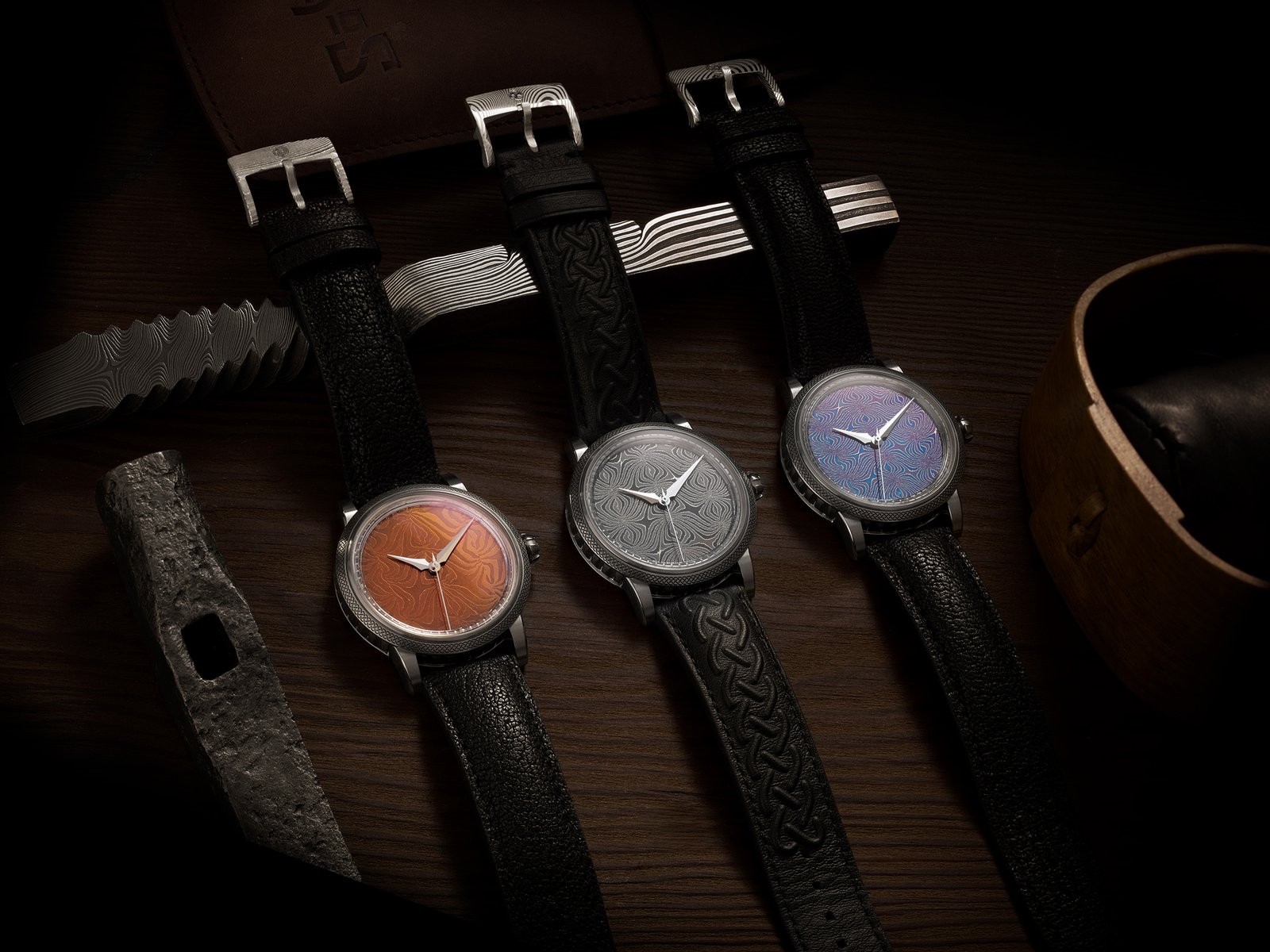
Pattern-welded steel – the forge-welded combination of different alloys used by GoS – has its roots in the Celtic and Viking-era smithing traditions of northern Europe, and dates back to around 300 to 500 AD. Today, knife makers continue to build their careers around the material, which is most often used for high-end knives, swords and jewellery. The surface patterns that make a billet beautiful are precisely what make it so challenging to finish to the flatness and proportions required for a watch dial.
In 2007, Swedish watchmaker Patrik Sjögren and master bladesmith Johan Gustafsson decided to use it for watch dials anyway, creating the brand GoS. Almost two decades later, GoS Watches remains one of the few workshops in the world continuing to work with the material at this level.
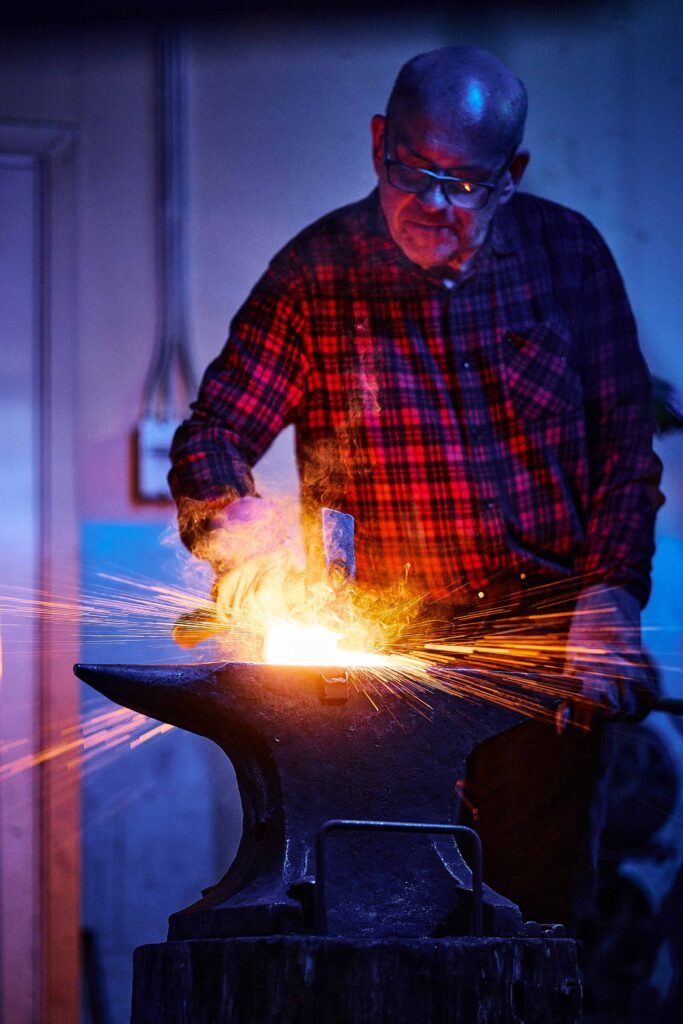
GoS is short for Gustafsson och Sjögren and produces 20 to 30 watches a year, made to order, with a six-to-eight-month wait between commission and delivery. Sjögren has led the brand independently since 2021, when Gustafsson stepped back, while master bladesmith Conny Persson (below) joined to continue the forging work. Production is centred in Linköping, with an engraver working remotely from Sweden’s west coast. Around half of the watches are sold directly to clients, often in bespoke configurations; the remainder are distributed through retailers, reaching collectors in the United States, Europe, the Middle East and Southeast Asia.
What sets GoS apart is the material itself – and this is why reason few other watchmakers have attempted to follow the same path.
When steel sets the rules
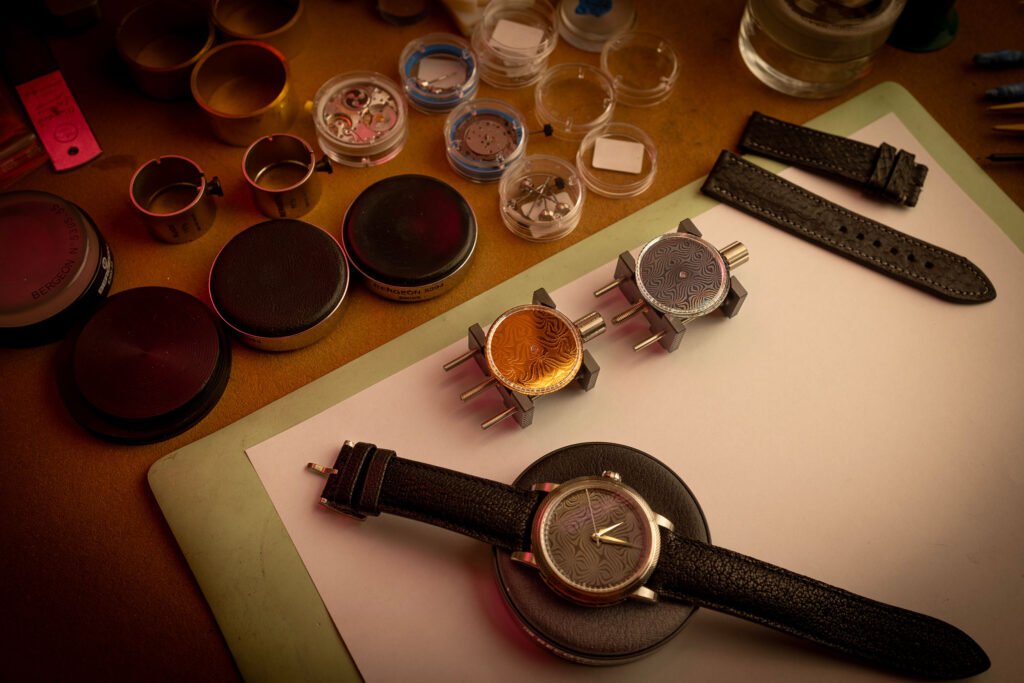
The pattern only reveals itself once the surface is etched, and no two billets are ever identical. Every fold, twist and stack of layers created before the steel is fused produces a different result. That unpredictability suits a knife blade, but it presents a significant challenge for serial dial production.
A dial blank must be flat, thin and clean enough to accept indices, hands and a printed minute track without distortion. It must then be etched with precision so the layered pattern emerges without compromising the surface. The finishing is a discipline in itself, and one that does not transfer easily from the cutlery side of the trade.
“I’ve often had to educate buyers on how Damascus steel is forged and finished, so they understand the expertise required to do what we do at GoS with that material,” says Sjögren. “I’m also trained as a service watchmaker, which means I always keep serviceability in mind when I design a watch. Every GoS piece should be serviceable by any trained watchmaker experienced in high-end work, without any custom tooling.”
A handful of other brands have experimented with Damascus dials in the years since GoS introduced them. Few have stayed with the material long enough to develop the workshop knowledge required to work with it consistently. The bladesmith partnership is central to GoS’s ability to sustain that approach: dial steel is not knife steel, and the balance between forging and finishing only holds because the same workshops have been refining the process together for years – first with Johan Gustafsson, then with Conny Persson, who specialises in mosaic Damascus and has been forging pattern-welded steel since the early 1990s.
Sweden, on the dial
Among GoS’s best-known creations is the Väring, the brand’s Viking-era model. The first generation has now been fully allocated, while a second-generation Väring is in development, this time housed in a bronze case that Sjögren plans to pre-patinate before delivery. The surface will continue to evolve on the wrist rather than beginning from untouched metal.
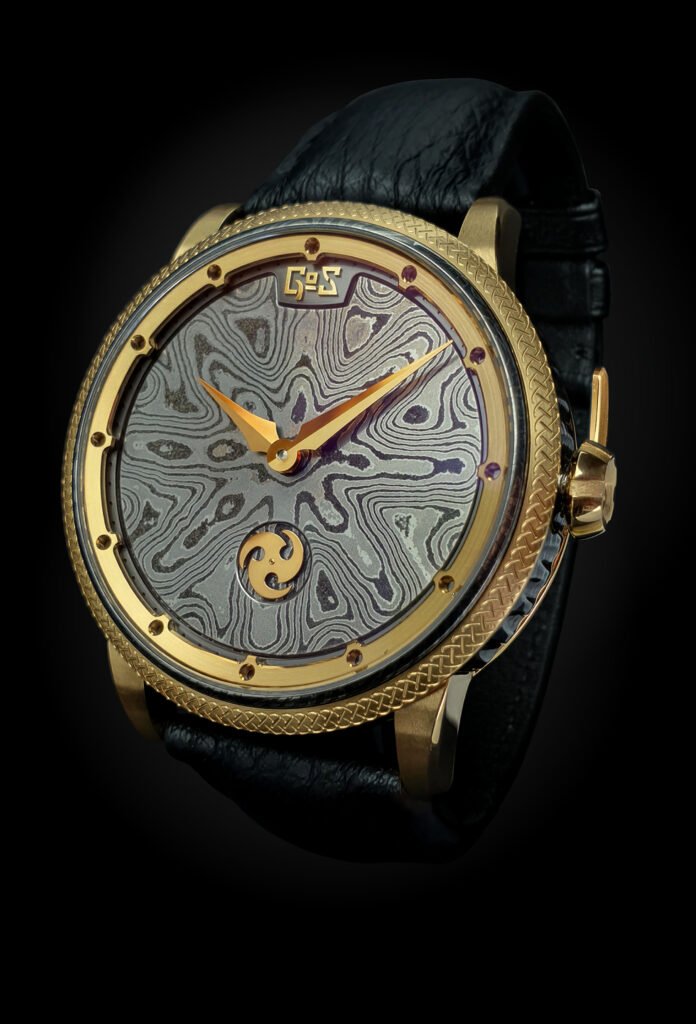
Elsewhere, GoS draws its design vocabulary from the Swedish landscape and history without relying heavily on familiar iconography. The Winter Nights line (below), for example, allows the Damascus pattern itself to provide the visual language that engravings or appliqués might create elsewhere.
Several GoS models carry no visible logo, or one so discreet it requires a closer look. Sjögren’s aim is for the case profile and dial geometry to create the recognition that a logo would otherwise provide – an approach that only works when the design language is coherent enough to stand independently.
A movement that probably shouldn’t have worked
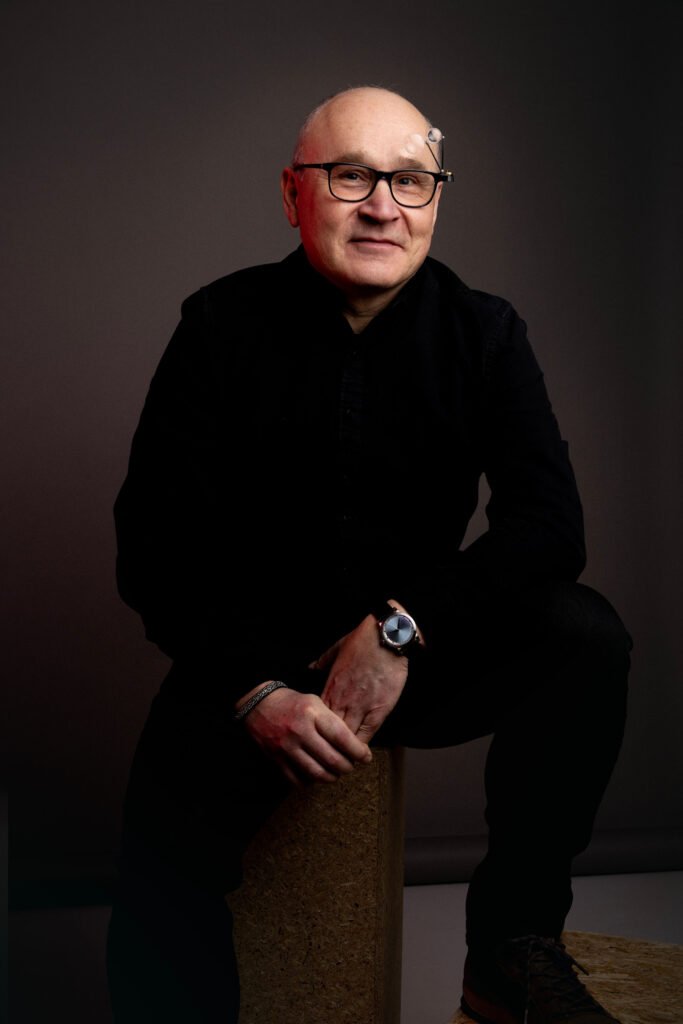
Five years into the brand, Sjögren (above) commissioned something unusually ambitious for a workshop of GoS’s size: a manufacture movement created in collaboration with German watchmaker Martin Braun, incorporating Damascus steel components directly into the calibre itself. The first generation of Winter Nights was the result.
“Possibly a bit naive,” says Sjögren, reflecting on the decision today. Bringing it to life relied on his background as an engineer before becoming a watchmaker – a problem-solving instinct that, he says, allows him to achieve more in his workshop than the available tooling might suggest is possible. Winter Nights demonstrated that GoS could develop a manufacture calibre alongside its dial work, rather than simply commission Swiss base movements and decorate them. The third generation of Winter Nights competes in the Artistic Crafts category of this year’s edition of Le Grand Prix d’Horlogerie de Genève, the watch world’s equivalent to the Oscars.
A second manufacture movement is now in development, designed by Sjögren and built in partnership with a Swiss watchmaker whose identity he is not yet ready to disclose. He is targeting an announcement in spring 2027.
Understanding watches inside out
One aspect of Sjögren’s background influences more of the watches than is immediately apparent: he is trained in servicing and repairing watches, with a focus on understanding how mechanical timepieces are maintained and preserved over time. He completed his studies at the Swedish watchmaking school and earned the Breitling scholarship at graduation, which sent him to Breitling for training in the summer of 2007 – the same year GoS was founded. He still owns the Cosmonaute he received at graduation, built around the movement he trained on that summer.
That understanding carries through into how GoS watches are designed. This standard sounds unremarkable until compared with the broader independent landscape, where proprietary modules and one-off assemblies have created a generation of watches that effectively have to return to their maker – or eventually stop running.
GoS has grown without outside investors, which Sjögren credits with allowing the design language to evolve at its own pace – from the mood boards he assembled around twelve years ago into what is now a cleaner, more refined line that remains connected to the original references.
What hasn’t changed
Making just 20 to 30 watches a year, GoS cannot supply dealers in volume. At the level of finishing required for a Damascus dial, aggressive batching would compromise the very qualities that make the material distinctive. Each piece is effectively unique in pattern, even when case and movement configurations are shared across
the collection.
That philosophy will continue with the second-generation Väring and third-generation Winter Nights, as it will with the second manufacture calibre. Nothing is announced before it exists. That has been the approach at the workshop in Linköping since 2007.
Discover more
goswatches.com